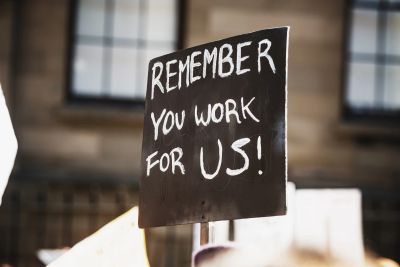
I am running to represent the people of Georgia’s 14th Congressional District — not a political party.
I believe government works best when ideas are judged by what they accomplish for the people, not by whether they carry a Republican or Democratic label. Political disagreement will always exist. The question is whether our differences help us find better answers or become divisions that prevent government from serving the people at all.
THE FOUNDERS WARNED ABOUT FACTION
Concern about political factions is almost as old as the United States itself.
In his 1796 Farewell Address, George Washington warned Americans about the “spirit of party” and what he considered its dangers to representative government. He feared that one faction repeatedly seeking power over another could deepen division, weaken government and place party interests ahead of the public good.
Learn more: Read George Washington’s Farewell Address at the Library of Congress
James Madison approached the problem somewhat differently. In Federalist No. 10, Madison recognized that factions are inevitable because people naturally have different beliefs, interests and priorities. His concern was how a republic could prevent a faction from becoming powerful enough to sacrifice the rights of others or the broader public good to its own interests.
Learn more: Read James Madison’s Federalist No. 10 at Founders Online, National Archives
Washington and Madison did not make identical arguments, but both recognized a fundamental problem: political factions can become dangerous when winning and maintaining power become more important than governing for the whole country.
A GROWING POLITICAL DISCONNECT
Today, a remarkable number of Americans do not identify with either major political party.
Gallup found that a record 45% of U.S. adults identified as political independents in 2025, compared with 27% who identified as Democrats and 27% as Republicans. Independents therefore represented the largest single political-identification category measured by Gallup. Many independents still lean toward one of the major parties, so independent identification should not automatically be interpreted as rejection of both parties.
There is another measure of political disconnection as well. An October 2025 Overton Insights survey of 1,200 registered voters asked whether respondents considered themselves “politically homeless” — specifically meaning that they did not feel represented by either major party. 40% answered yes.
Being independent and being politically homeless are not the same thing, and these groups overlap. But both measurements show that a substantial portion of Americans do not identify comfortably within the traditional two-party structure.
THE MISSING VOICES
There is another issue that should be considered separately: millions of voting-age citizens do not vote at all.
According to the U.S. Census Bureau, 65.3% of the citizen voting-age population voted in the 2024 presidential election. That means roughly one in three voting-age citizens did not vote.
Participation falls even further during congressional midterm elections. In 2022, 52.2% of voting-age citizens voted, meaning nearly one in two did not.
People choose not to vote for many different reasons. These statistics should not be interpreted as evidence that every nonvoter has rejected the two major parties. But whatever the reason, when someone does not participate, that person’s voice is not expressed through the ballot box.
And there are voices that cannot yet be heard at the ballot box — our young people. They may not be old enough to vote, but the decisions we make today will shape the country they inherit tomorrow. Their ideas, concerns and hopes matter too. They deserve to be heard, included and taken seriously, because they are not only our future — they are part of our communities right now.
To me, that is something worth changing. Our representative government is strongest when people believe their participation matters and that someone is listening when they speak.
WHAT “PEOPLE OVER PARTIES” MEANS TO ME
I am an Independent because I do not believe representing the people should require allegiance to a political party.
That does not mean Republicans are always wrong, Democrats are always wrong, or Independents are always right. Good ideas can come from anywhere.
My standard is simpler:
Is this a good idea for the people I represent?
If a Republican has a good idea, I can work with that Republican.
If a Democrat has a good idea, I can work with that Democrat.
If an Independent, Libertarian or someone with no political affiliation at all has a good idea, I can work with that person too.
The people of Georgia’s 14th District will not all agree with one another — and they should not have to. Representation means listening to all of them, weighing the facts and making decisions based on what best serves the district and the country.
That is what People Over Parties means to me.
Government should belong to the people.
Your voice should matter.
And no political party should ever be more important than the people it was created to serve.
Rob Rush